
By HIT Media (Text by Peixiang Liu, Yusheng Ci, and Haocheng Xu). A research team led by Prof. Yusheng Ci and Prof. Ci Liang from the School of Transportation Science and Engineering at Harbin Institute of Technology (HIT) has recently made significant progress in autonomous driving safety. The team proposed a Generalized Adaptive Adversarial Training Framework, termed GA2AD, which enables the controlled generation of high-risk interaction scenarios, substantially enhancing the safety and robustness of autonomous vehicles in mixed traffic environments. The work, titled “GA2AD: A Generalized Adaptive Adversarial Training Framework Considering Surrounding Hybrid Risk Field for Autonomous Driving,” has been published in Nature Communications.
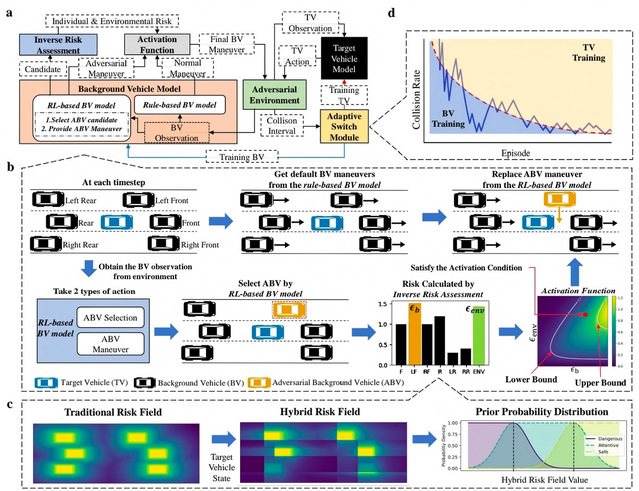
Architecture of the GA2AD framework with adaptive adversarial training
In mixed-traffic settings where autonomous vehicles and human-driven vehicles coexist over the long term, rare human driving behaviors—such as sudden cut-ins, emergency braking, and abnormal acceleration—can expose weaknesses in autonomous driving decision-making systems and constitute typical long-tail edge cases. Conventional training data are often insufficient to cover such rare but hazardous events. To address this challenge, the research team treated the autonomous driving decision model as a “black box” and trained a background-vehicle model to actively generate adversarial behaviors. The core innovations are threefold: constructing a hybrid risk field to enable probabilistic assessment of both individual-vehicle and overall environmental risks; designing an activation function to maintain an appropriate level of adversarial intensity; and introducing an adaptive switching module that dynamically adjusts scenario difficulty as the model’s capabilities evolve, thereby mitigating training instability.
Simulation results demonstrate that GA2AD is compatible with multiple mainstream algorithms, including DQN, TD3, SAC, and DDPG. Under normal testing, collision rates were reduced by 69.31%; under adversarial testing, they were reduced by 55.24%. The 95th percentile absolute jerk decreased by 21.23% and 42.35%, respectively, while average speed decreased only marginally, indicating an effective balance among safety, comfort, and traffic efficiency.
Further validation was conducted through vehicle-in-the-loop mixed-reality tests at the Heihe Autonomous Driving Proving Ground in Heilongjiang, China. By injecting virtual background traffic in real time into the physical vehicle’s perception system, the proportion of high-risk scenarios with a time to collision below 2 seconds increased from 0.60% to 34.97% (an approximately 58-fold increase). Among the tested algorithms, the DDPG policy trained with GA2AD exhibited the lowest frequency of near-collision events and the highest frequency of evasive maneuvers, demonstrating the feasibility of deploying adversarially trained policies on a physical vehicle platform. This research provides a systematic theoretical and methodological foundation for identifying weaknesses in autonomous driving decision-making systems, generating high-value hazardous scenarios, and conducting closed-loop reinforcement training.
Harbin Institute of Technology is the first institutional affiliation of the paper. Haocheng Xu, a doctoral student at the School of Transportation Science and Engineering, is the first author. Professors Yusheng Ci and Ci Liang of Harbin Institute of Technology, together with Lina Wu of Heilongjiang Institute of Technology, are co-corresponding authors. Yunfei Long from Harbin Engineering University, Xiqun Chen from Zhejiang University, Mohamed Ghazel from Gustave Eiffel University, and Lei Feng from KTH Royal Institute of Technology also contributed to the research. This work was supported by the National Key R&D Program of China, the National Natural Science Foundation of China, the Natural Science Foundation of Heilongjiang Province, and other funding sources. The Heihe Autonomous Driving Proving Ground provided site access and technical support for the field tests.
Link to paper:
https://www.nature.com/articles/s41467-026-75643-z
